Back
|
-

Carbon Unbound West Coast 2026 Emissions Report

Our first published event emissions report reinforces our commitment to be accountable and fully transparent about our event’s impacts and, above all else, it gets us closer to our ultimate goal: becoming net-negative.
Read article
Summit Content
Canada

This article requires a membership.

Didn’t get a ticket to Carbon Unbound East Coast 2024, but want to listen to all the sessions on-demand? Create a free profile and purchase access through your account.

Start
No items found.

This report provides an overview of the Unbound Summit’s conference series, Carbon Unbound and Adapt Unbound held worldwide over the past years, along with the carbon emissions associated with these events. It highlights the key sources of impact and outlines practical steps Unbound can take to reduce its footprint and contribute meaningfully to the Net Zero 2030 goal. This is our effort to quantify emissions with reference to the GHG Protocol Corporate Accounting and Reporting Standard, and we are working toward fuller alignment in future reporting cycles.

Aim & Priorities

Aim

We aim to reduce the carbon footprint of our conferences and move steadily towards net-zero, and then net-negative, while continuing to deliver high-quality events for our clients and delegates.

Our Priorities

Understanding our emissions

We will be improving how we collect and calculate emissions data so we can make more informed decisions and track real progress.

Taking practical action

We are identifying realistic, achievable ways to reduce emissions across event planning, suppliers, venues, and logistics.

Building a clear pathway to Net Zero

Using what we learn from our emissions data, we will be developing a long-term plan to reduce our impact year by year.

Scope & Boundaries

The organisational and operational boundaries for this report has been prepared with reference to the Greenhouse Gas Protocol Corporate Accounting and Reporting Standard and Scope 3 guidance. This report covers event related emissions for Carbon Unbound West Coast 2026 only. For this report, Unbound has defined the boundary using an event-operational approach.

Organisational Boundaries
The event boundary includes emissions that occur:
  • During the defined event dates
  • From travel directly associated with attending the event (Attendee and staff travel to and from the event (flights, trains, cars))
  • From goods and services procured specifically for event delivery
    • Venue energy use during the event
    • Catering, materials and supplies used specifically for the event
    • Event-related transportation, e.g., equipment delivery, shuttles
  • Accommodation for a 2-night stay for all the attendees.
Unbound does not own or control:
  • Venue buildings
  • Utility contracts
  • On-site infrastructure
  • Accommodations booked by attendees
Excluded from this boundary:
  • Corporate office operations
  • Employee commuting unrelated to event travel
  • Attendee activities unrelated to event participation
  • Digital platform and software emissions
  • Supply chain impacts beyond event-specific procurement
Reporting Period

Carbon Unbound West Coast: 22–23 January 2026, Vancouver, Canada.

This event-based inventory represents the first phase of Unbound’s climate reporting. Future annual reporting will expand the boundary to include:

  • Office/workspace energy use
  • Employee commuting
  • Business travel beyond events
  • Digital infrastructure and software usage
  • Broader supply chain categories
Operational Boundary

Unbound does not own physical assets or purchase utilities directly for these events, the majority of emissions fall under Scope 3 (Indirect Emissions).

Scope 1 – Direct Emissions

None identified for the event inventory. Unbound does not own or operate fuel-combusting assets at event sites.

Scope 2 – Purchased Electricity

Not applicable. Electricity consumed at event venues is purchased and controlled by the venue operator. Therefore, it is categorized as Scope 3.

Scope 3 – Other Indirect Emissions
  • Attendee travel (air, rail, car)
  • Speaker and staff travel
  • Accommodation (2-night assumption)
  • Venue energy use during event days (as purchased service)
  • Catering (food production emissions)
  • Materials and temporary infrastructure
  • Waste generation and treatment
  • Event-related logistics and transport

Path Forward

Sustainability remains central to our events strategy. Our actions have been structured under the following key categories and we will continue to work towards these strategies and strengthen them to be in line with Net Zero targets.

1. Sustainable Venues

Our venue selection includes properties that demonstrate established sustainability policies, certifications, and measurable operational practices.

Many of the venues we partner with already implement:
  • Reusable serviceware and elimination of single-use plastics
  • Waste diversion programs (recycling and composting)
  • Energy-efficient building systems
  • Renewable energy procurement (where available)
  • Third-party certifications (e.g., LEED, BREEAM, Green Tourism, etc.)
We will formalize our due diligence process by:
  • Requesting documentation of venue sustainability certifications and policies
  • Assessing energy sourcing (renewable %, grid mix where available)
  • Reviewing waste diversion and food recovery programs
  • Prioritizing venues with measurable energy intensity data (kWh/m²)

Where possible, we will collaborate with venues to align on shared environmental performance indicators.

Note: Venue operations account for a portion of event-related emissions; however, building-level energy supply and infrastructure remain outside our direct operational control

2. Sustainable Food & Catering

Food production is a material contributor to event emissions, particularly through animal-based products.

Current approach:
  • Vegetarian and vegan menus served by default
  • Reduction of high-emission food categories (e.g., red meat)
Future development:
  • Estimating food-related emissions per attendee (kgCO₂e per meal)
  • Tracking food waste diversion rates
  • Prioritizing locally sourced and seasonal options where feasible

We will aim to quantify food-related emissions using published lifecycle assessment (LCA) benchmarks where direct supplier data is unavailable.

3. Materials & Production

We aim to reduce embodied emissions associated with temporary event materials.

Current actions include:
  • Reusable banners and signage where feasible
  • Reduction in printed materials through digital program
  • Preference for recyclable or compostable materials
Future development:
  • Tracking total printed material weight per event
  • Increasing reusable asset percentage year-on-year
  • Evaluating supplier environmental policies

We recognize that embodied carbon from short-life assets can be disproportionately high relative to use duration and will prioritize reduction accordingly.

4. Travel & Carbon Footprint Management

Attendee and speaker travel represents the largest source of event-related emissions.

The current limitation is to capture primary, granular travel data for the entire attendee base, leading to estimated averages and secondary data for carbon reporting

Next steps:
  • Collect granular voluntary travel data during registration
  • In line emissions using methodology aligned with the GHG Protocol Scope 3 framework
  • Identify modal shift opportunities (rail vs air, etc.)
  • Encourage lower-carbon travel options where geographically viable

Where residual emissions remain unavoidable, we will assess high-integrity carbon removal or reduction solutions

5. Waste Management

Current practice:

  • Waste segregation at event sites
  • Collaboration with venue waste management systems
Future improvements:
  • Tracking total waste generated (kg per attendee)
  • Monitoring diversion rate (%)
  • Reducing waste intensity year-on-year

We recognize that accurate waste measurement depends partly on venue-level reporting systems.

6. Partnerships & Climate Action

We work with climate-focused initiatives, including partnerships such as Milkywire’s Climate Transformation Fund.

Going forward:

Separate operational reduction strategy from contribution strategy

Report contributions transparently and distinctly from emissions reduction

Total Emissions: 600.47 tons

Mobility: 563.5 tons

Accommodation: 27.7 tons

Catering: 5.2 tons

Material: 3.2 tons

Waste: 0.867 tons

Visualising Our Emissions
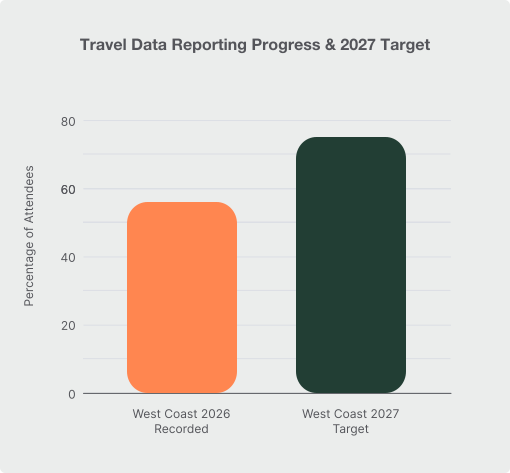
Figure 1: Travel Data Reporting Progress & 2027 Target. In 2026, 55% of attendees shared their travel data, forming the basis for carbon measurement.  The 2027 goal of 75% is designed to strengthen emissions tracking accuracy and enhance accountability.
Figure 2: Event Carbon Footprint by Emissions Source. Attendee travel (mobility) accounts for the vast majority of total event emissions. Operational impacts such as accommodation, catering, materials, and waste contribute comparatively less.
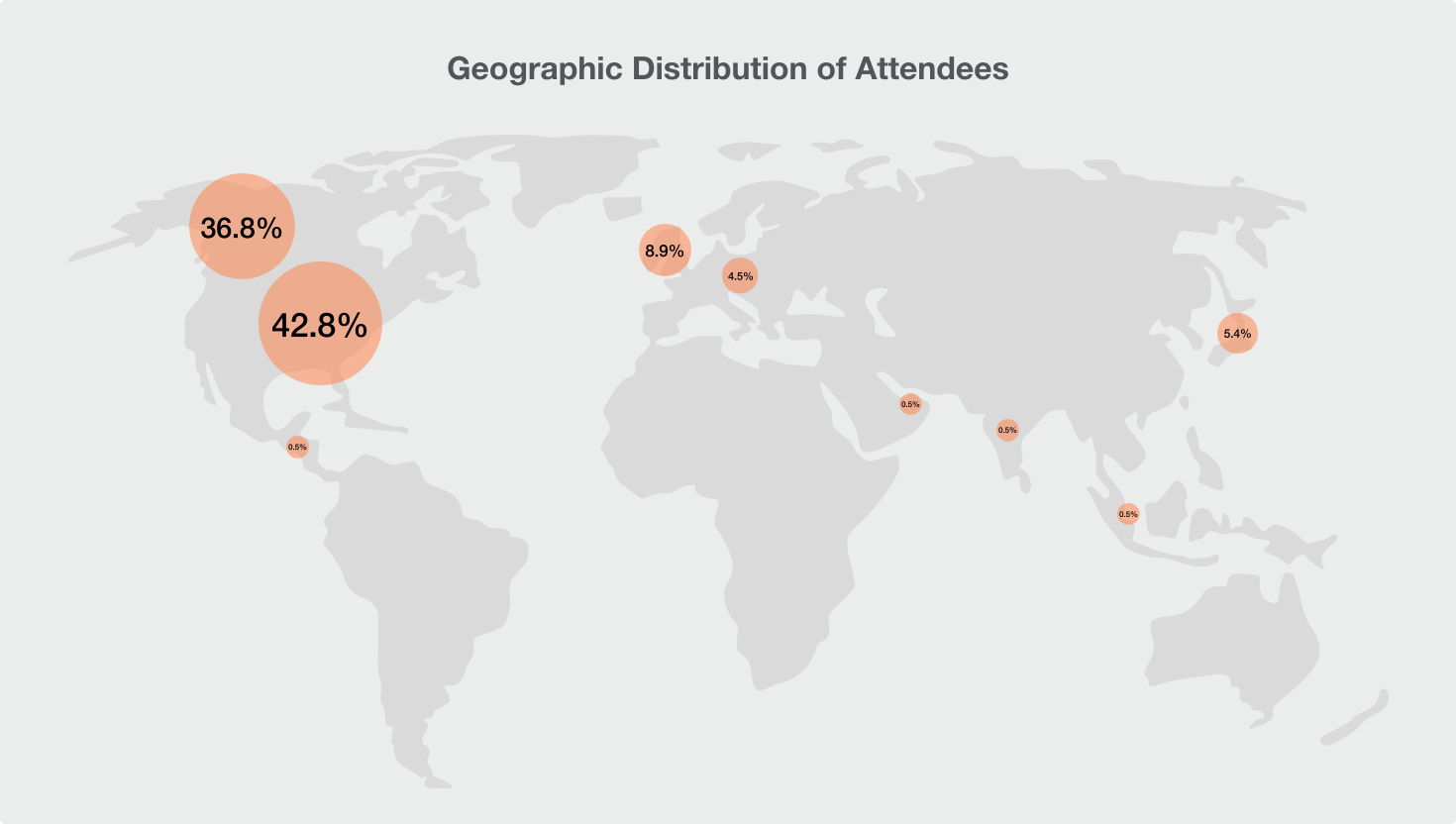
Figure 3: Geographic Distribution of Attendees. Most attendees were U.S.-based, with strong representation from both East and West Coasts. Other International attendance is relatively small, but the longer distances traveled mean these participants likely account for a substantial share of overall travel emissions.

Assumptions for Event Emissions Calculation

The following assumptions were applied to ensure consistency and transparency in estimating emissions associated with the event. These assumptions are based on attendee provided travel information and standardized methods from carbon emission calculators.

Boundary: Event-Based Emissions

Event-based emissions are those directly associated with organizing and running the event. This includes:

  • Attendee and staff travel to and from the event (flights, trains, cars)
  • Venue energy use during the event
  • Catering, materials, and supplies used specifically for the event
  • Event-related transportation, e.g., equipment delivery, shuttles
  • Accommodation for a 2-night stay
Data Methodology & Integrity
  • Data Quality Hierarchy: Where specific data was unavailable, emissions were estimated using conservative standardized assumptions.
  • Conservative Bias: In cases of uncertainty, assumptions were made conservatively to avoid underestimating emissions.
  • Continuous Improvement: Future reports will improve data accuracy through direct supplier reporting and attendee travel surveys.
Assumptions Used for Calculations
Flights
  • All flights were assumed to be direct.
  • Emissions were calculated for round trips to the starting point.
  • All flights were assumed to be economy class.
  • The travel starting point was assumed to be the nearest international airport to the attendee’s city/country.
  • If attendees could not provide specific travel information, their travel was estimated as a flight from the capital city of the country provided in their address.
Cars
  • All cars were assumed to use E10 fuel.
  • All cars were assumed to be mid-range vehicles.
  • For attendees traveling by air, emissions for travel from Toronto International Airport to the venue were included.
Trains
  • All trains were assumed to be light rail.
Accommodation
  • Specific emissions associated with attendee accommodation were not included.
  • The values reported are based on empirical calculations from the event calculator used.
Catering, Materials & Waste
  • Emissions were generated based on empirical calculations from the event calculator.
surbhi@unboundsummits.com
minute read
minute listen
February 26, 2026
Surbhi
Sharma
29 Jun 2024
References
Carbon Unbound West Coast 2026 Emissions Report

Watch on demand

Register

for

By submitting this form, you agree to receive email updates and communications related to our events. You can unsubscribe at any time via the link in our emails.
For more details see our Privacy Policy.

Thank you

Please check your inbox for confirmation of your reservation.
Please check your inbox for your on-demand viewing link.
Sorry, we couldn't send your registration. Please refresh the page and try again.
No items found.

This report provides an overview of the Unbound Summit’s conference series, Carbon Unbound and Adapt Unbound held worldwide over the past years, along with the carbon emissions associated with these events. It highlights the key sources of impact and outlines practical steps Unbound can take to reduce its footprint and contribute meaningfully to the Net Zero 2030 goal. This is our effort to quantify emissions with reference to the GHG Protocol Corporate Accounting and Reporting Standard, and we are working toward fuller alignment in future reporting cycles.

Aim & Priorities

Aim

We aim to reduce the carbon footprint of our conferences and move steadily towards net-zero, and then net-negative, while continuing to deliver high-quality events for our clients and delegates.

Our Priorities

Understanding our emissions

We will be improving how we collect and calculate emissions data so we can make more informed decisions and track real progress.

Taking practical action

We are identifying realistic, achievable ways to reduce emissions across event planning, suppliers, venues, and logistics.

Building a clear pathway to Net Zero

Using what we learn from our emissions data, we will be developing a long-term plan to reduce our impact year by year.

Scope & Boundaries

The organisational and operational boundaries for this report has been prepared with reference to the Greenhouse Gas Protocol Corporate Accounting and Reporting Standard and Scope 3 guidance. This report covers event related emissions for Carbon Unbound West Coast 2026 only. For this report, Unbound has defined the boundary using an event-operational approach.

Organisational Boundaries
The event boundary includes emissions that occur:
  • During the defined event dates
  • From travel directly associated with attending the event (Attendee and staff travel to and from the event (flights, trains, cars))
  • From goods and services procured specifically for event delivery
    • Venue energy use during the event
    • Catering, materials and supplies used specifically for the event
    • Event-related transportation, e.g., equipment delivery, shuttles
  • Accommodation for a 2-night stay for all the attendees.
Unbound does not own or control:
  • Venue buildings
  • Utility contracts
  • On-site infrastructure
  • Accommodations booked by attendees
Excluded from this boundary:
  • Corporate office operations
  • Employee commuting unrelated to event travel
  • Attendee activities unrelated to event participation
  • Digital platform and software emissions
  • Supply chain impacts beyond event-specific procurement
Reporting Period

Carbon Unbound West Coast: 22–23 January 2026, Vancouver, Canada.

This event-based inventory represents the first phase of Unbound’s climate reporting. Future annual reporting will expand the boundary to include:

  • Office/workspace energy use
  • Employee commuting
  • Business travel beyond events
  • Digital infrastructure and software usage
  • Broader supply chain categories
Operational Boundary

Unbound does not own physical assets or purchase utilities directly for these events, the majority of emissions fall under Scope 3 (Indirect Emissions).

Scope 1 – Direct Emissions

None identified for the event inventory. Unbound does not own or operate fuel-combusting assets at event sites.

Scope 2 – Purchased Electricity

Not applicable. Electricity consumed at event venues is purchased and controlled by the venue operator. Therefore, it is categorized as Scope 3.

Scope 3 – Other Indirect Emissions
  • Attendee travel (air, rail, car)
  • Speaker and staff travel
  • Accommodation (2-night assumption)
  • Venue energy use during event days (as purchased service)
  • Catering (food production emissions)
  • Materials and temporary infrastructure
  • Waste generation and treatment
  • Event-related logistics and transport

Path Forward

Sustainability remains central to our events strategy. Our actions have been structured under the following key categories and we will continue to work towards these strategies and strengthen them to be in line with Net Zero targets.

1. Sustainable Venues

Our venue selection includes properties that demonstrate established sustainability policies, certifications, and measurable operational practices.

Many of the venues we partner with already implement:
  • Reusable serviceware and elimination of single-use plastics
  • Waste diversion programs (recycling and composting)
  • Energy-efficient building systems
  • Renewable energy procurement (where available)
  • Third-party certifications (e.g., LEED, BREEAM, Green Tourism, etc.)
We will formalize our due diligence process by:
  • Requesting documentation of venue sustainability certifications and policies
  • Assessing energy sourcing (renewable %, grid mix where available)
  • Reviewing waste diversion and food recovery programs
  • Prioritizing venues with measurable energy intensity data (kWh/m²)

Where possible, we will collaborate with venues to align on shared environmental performance indicators.

Note: Venue operations account for a portion of event-related emissions; however, building-level energy supply and infrastructure remain outside our direct operational control

2. Sustainable Food & Catering

Food production is a material contributor to event emissions, particularly through animal-based products.

Current approach:
  • Vegetarian and vegan menus served by default
  • Reduction of high-emission food categories (e.g., red meat)
Future development:
  • Estimating food-related emissions per attendee (kgCO₂e per meal)
  • Tracking food waste diversion rates
  • Prioritizing locally sourced and seasonal options where feasible

We will aim to quantify food-related emissions using published lifecycle assessment (LCA) benchmarks where direct supplier data is unavailable.

3. Materials & Production

We aim to reduce embodied emissions associated with temporary event materials.

Current actions include:
  • Reusable banners and signage where feasible
  • Reduction in printed materials through digital program
  • Preference for recyclable or compostable materials
Future development:
  • Tracking total printed material weight per event
  • Increasing reusable asset percentage year-on-year
  • Evaluating supplier environmental policies

We recognize that embodied carbon from short-life assets can be disproportionately high relative to use duration and will prioritize reduction accordingly.

4. Travel & Carbon Footprint Management

Attendee and speaker travel represents the largest source of event-related emissions.

The current limitation is to capture primary, granular travel data for the entire attendee base, leading to estimated averages and secondary data for carbon reporting

Next steps:
  • Collect granular voluntary travel data during registration
  • In line emissions using methodology aligned with the GHG Protocol Scope 3 framework
  • Identify modal shift opportunities (rail vs air, etc.)
  • Encourage lower-carbon travel options where geographically viable

Where residual emissions remain unavoidable, we will assess high-integrity carbon removal or reduction solutions

5. Waste Management

Current practice:

  • Waste segregation at event sites
  • Collaboration with venue waste management systems
Future improvements:
  • Tracking total waste generated (kg per attendee)
  • Monitoring diversion rate (%)
  • Reducing waste intensity year-on-year

We recognize that accurate waste measurement depends partly on venue-level reporting systems.

6. Partnerships & Climate Action

We work with climate-focused initiatives, including partnerships such as Milkywire’s Climate Transformation Fund.

Going forward:

Separate operational reduction strategy from contribution strategy

Report contributions transparently and distinctly from emissions reduction

Total Emissions: 600.47 tons

Mobility: 563.5 tons

Accommodation: 27.7 tons

Catering: 5.2 tons

Material: 3.2 tons

Waste: 0.867 tons

Visualising Our Emissions
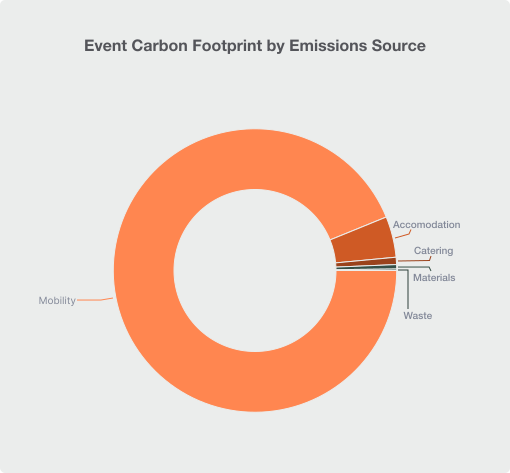
Figure 1: Travel Data Reporting Progress & 2027 Target. In 2026, 55% of attendees shared their travel data, forming the basis for carbon measurement.  The 2027 goal of 75% is designed to strengthen emissions tracking accuracy and enhance accountability.
Figure 2: Event Carbon Footprint by Emissions Source. Attendee travel (mobility) accounts for the vast majority of total event emissions. Operational impacts such as accommodation, catering, materials, and waste contribute comparatively less.
Figure 3: Geographic Distribution of Attendees. Most attendees were U.S.-based, with strong representation from both East and West Coasts. Other International attendance is relatively small, but the longer distances traveled mean these participants likely account for a substantial share of overall travel emissions.

Assumptions for Event Emissions Calculation

The following assumptions were applied to ensure consistency and transparency in estimating emissions associated with the event. These assumptions are based on attendee provided travel information and standardized methods from carbon emission calculators.

Boundary: Event-Based Emissions

Event-based emissions are those directly associated with organizing and running the event. This includes:

  • Attendee and staff travel to and from the event (flights, trains, cars)
  • Venue energy use during the event
  • Catering, materials, and supplies used specifically for the event
  • Event-related transportation, e.g., equipment delivery, shuttles
  • Accommodation for a 2-night stay
Data Methodology & Integrity
  • Data Quality Hierarchy: Where specific data was unavailable, emissions were estimated using conservative standardized assumptions.
  • Conservative Bias: In cases of uncertainty, assumptions were made conservatively to avoid underestimating emissions.
  • Continuous Improvement: Future reports will improve data accuracy through direct supplier reporting and attendee travel surveys.
Assumptions Used for Calculations
Flights
  • All flights were assumed to be direct.
  • Emissions were calculated for round trips to the starting point.
  • All flights were assumed to be economy class.
  • The travel starting point was assumed to be the nearest international airport to the attendee’s city/country.
  • If attendees could not provide specific travel information, their travel was estimated as a flight from the capital city of the country provided in their address.
Cars
  • All cars were assumed to use E10 fuel.
  • All cars were assumed to be mid-range vehicles.
  • For attendees traveling by air, emissions for travel from Toronto International Airport to the venue were included.
Trains
  • All trains were assumed to be light rail.
Accommodation
  • Specific emissions associated with attendee accommodation were not included.
  • The values reported are based on empirical calculations from the event calculator used.
Catering, Materials & Waste
  • Emissions were generated based on empirical calculations from the event calculator.

Get access to

By submitting this form, you agree to receive email updates and communications related to our events. You can unsubscribe at any time via the link in our emails.
For more details see our Privacy Policy.

Here's your password:

Enter it in the Airtable box below to access the list. The password is case sensitive.
Sorry, we couldn't send your registration. Please refresh the page and try again.

The List

Surbhi
Sharma
minute read
minute listen
February 26, 2026
Surbhi
Sharma
February 26, 2026
References

Latest articles

View all
Placeholder
Carbon Unbound West Coast 2026 Emissions Report
News & Reports
Unbound Reports
minute read
Feb 26, 2026
Placeholder
Behind the Agenda: Interview with Jodi Manning
Showcases
Accelerator / Incubator
Collaboration
2
minute read
Feb 19, 2026
Placeholder
Planeteers - Climate Technology Firm Interview
Showcases
Marine / Ocean Based Approaches
mCDR
minute read
Jan 29, 2026