.avif)
.avif)
Behind the Scenes of the Largest Biochar Offtake in US History
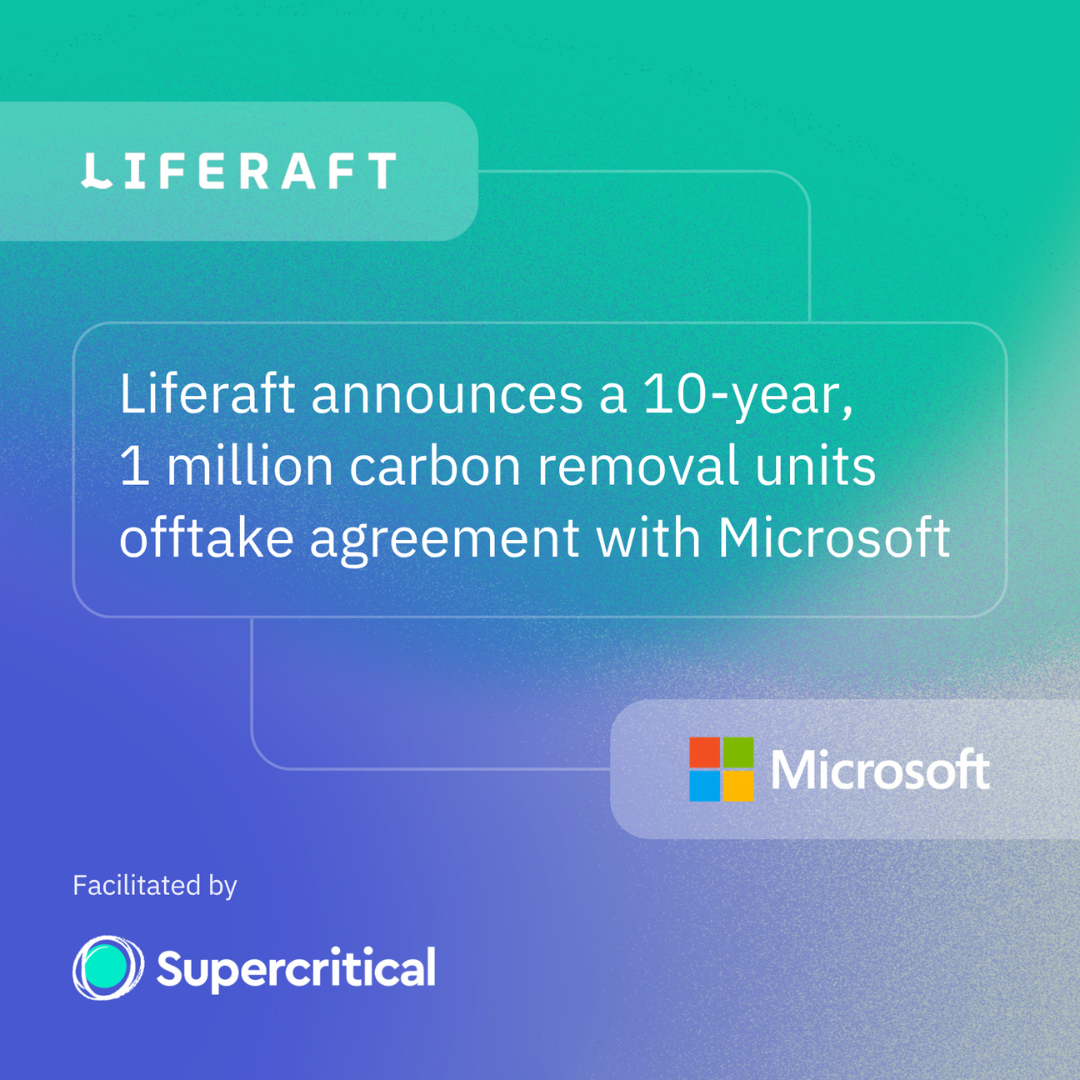
In an exclusive interview, Supercritical co-founder and CEO Michelle You shares insights into the largest biochar offtake in US history: a 1 million tonne, ten-year agreement between Liferaft and Microsoft. By supporting Liferaft from early project design through rigorous MRV, Supercritical helped enable durable carbon removal at an unprecedented scale across Iowa’s corn belt. Discover the strategic details behind the deal and how it came together in the full article below.
Behind the Deal
This is one of the largest biochar offtake agreements in the U.S. What made this deal possible now, and what had to be solved behind the scenes to reach this scale?
The market has matured. We've moved past the trial-and-error phase with small purchases, incremental commitments, years of proving before scaling. The buyers who are serious now know what rigorous looks like, and they want scale from day one. What made this deal possible was scaling the infrastructure around the project before the deal was signed. That meant project design work done upfront, MRV protocols to meet the buyer's standards, and a realistic delivery structure that reflected genuine ambition, not just what was feasible on paper.
Inside the Process
Supercritical supported the project from early-stage design, what specifically did that process involve, and how did it change the outcome versus a typical carbon removal project?
Project design means closing the gap between a promising idea and a signed deal. That means detailed engineering plans, life cycle assessment, audit-ready MRV, and commercial structures that hold up to corporate due diligence. Most early-stage projects don't have that infrastructure in place. They build it reactively, in response to buyer requests, which slows everything down and introduces risk on both sides. Our role is to engineer it upfront, so that when a serious buyer shows up, the project is ready.
What Comes Next
Do you see this deal as a one-off milestone, or a repeatable model for scaling high-quality carbon removal projects globally?
Repeatability is key. Through our supply development program, we commit to a project before it’s well-known. We engage in end-to-end co-development, covering climate science, commercial structuring, MRV, and brand building. This ensures that projects are designed from the ground up to meet the rigorous standards of serious buyers, ready for market success.
The Execution Challenge
What are the biggest execution risks over the 10-year delivery period, and how are you mitigating them today?
Biochar delivery faces real, project-specific risks across all stages, from feedstock logistics and pre-processing to machinery uptime and financing. Even experienced developers encounter these. Liferaft was well-positioned. Strong feedstock security, an experienced team, and a project designed from the start to meet rigorous standards. But smart project design only goes so far. Solutions require two approaches: at the project level, smart design means realistic delivery schedules, not best-case projections. At the portfolio level, buyers need a plan. To our customers, we offer buffer pools and pre-vetted replacement credits to account for inevitable real-world obstacles.
The Wider Impact
Beyond carbon removal, what measurable impacts do you expect on local communities, agriculture, and supply chains?
Biochar's co-benefits are not secondary to the carbon story. They're the reason this technology has support in ways that others don't. In West Liberty, Iowa, the project creates rural manufacturing jobs, turns agricultural waste into a productive input, and produces a soil amendment that reduces dependence on fossil-fuel-derived fertilizers. With synthetic fertilizer supply chains under pressure, that's not an abstract benefit. Mayor Mark Smith put it directly: “delivering much-needed jobs and local investment, which promise to be transformative” for the community.
Coming Up Next
How serious buyers are scaling carbon removal
Join Supercritical and Google on 5 May for “Getting Carbon Removal Right: A Buyer's Guide to Quality, Strategy, and First Steps" a webinar on quality, strategy, and smart first steps in CDR procurement. Learn from Michelle You (Supercritical) and Randy Spock (Google) how to avoid common pitfalls and build effective buying strategies. Register now to start your carbon removal journey with confidence.
.png)
Carbon Unbound East Coast 2026
Buyers' Workshop hosted by Supercritical
As part of Carbon Unbound East Coast, Supercritical is partnering with us on a private invite only Buyers' Workshop. Anchor buyer Google will help mature corporate buyers move from purchasing credits to scaling the CDR market through practical frameworks on procurement contracting due diligence and delivery risk with interactive breakouts and peer insights. Join Carbon Unbound East Coast on 19- 20 May to connect with leading buyers and practitioners and join the conversations shaping the next phase of CDR scale.
.jpg)


.png)